Updated 2026
Lumma Stealer was the stealer everyone talked about at the end of 2024, and the interesting engineering was not in the malware. It was in the plumbing: domains, dynamic DNS and a $50 add-on that kept one customer’s burned infrastructure from becoming everyone’s problem. The seller called those add-ons gaskets. The plumbing also leaked, which is why one court order could reach about 2,300 domains in a few days.
Context
Public facts here come from vendor and government reports, and each one is named. The gasket slang, the prices and the .fun registration pattern are my evidence, from Lumma’s main selling thread, the seller’s Telegram channel and my own tracking. I am not quoting the thread (the panel screenshots in section 5 are shown as posted), I am not naming anyone beyond the public alias the seller uses, and I am not confirming any personal detail about anyone. The investigation is ongoing. My earlier write-up of this family: LummaC2: Unpack & YARA.
1. What Lumma was, and when
Lumma (also LummaC2) was a malware-as-a-service stealer sold on Russian-speaking forums since at least mid-2022 (Red Canary). Tiers started at $250 a month. Microsoft lists four plans, $250, $500, $1,000 and $20,000 with source code. Microsoft tracks the developer, operator and infrastructure as Storm-2477 and says the developer, alias “Shamel”, sells through Telegram and Russian-language forums.
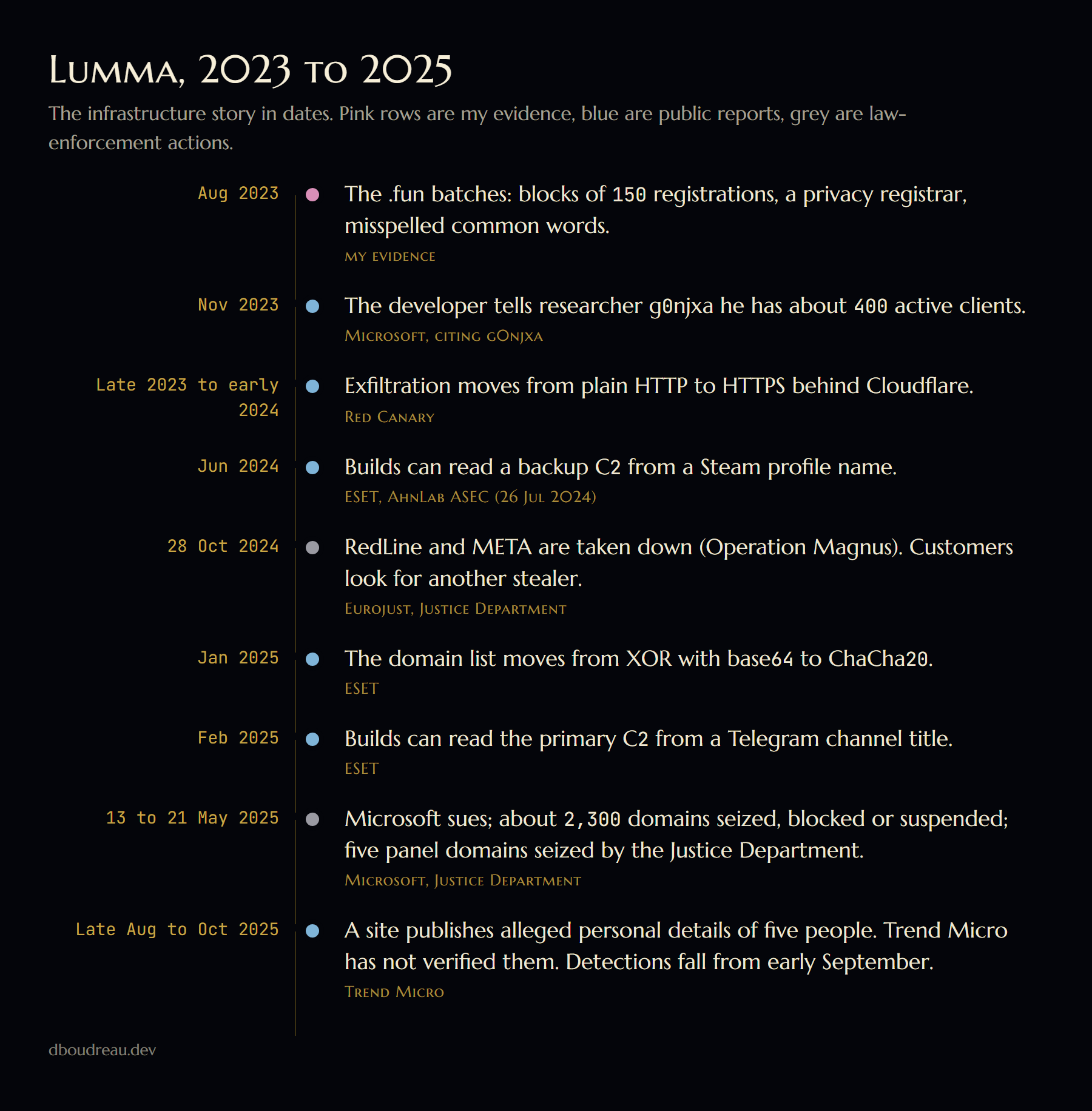
The shape of the business matters more than any one sample. In a November 2023 interview with the researcher g0njxa, the developer claimed about 400 active customers (the figure is the developer’s own, and Microsoft repeats it). By the end of 2024 the product had HTTPS exfiltration behind Cloudflare (moved over between late 2023 and early 2024, Red Canary) and, since June 2024, a fallback that does not need a rebuild: when a build’s own domains are dead it reads a Steam profile’s display name and decodes it (AhnLab ASEC, 26 July 2024). In October 2024 the RedLine and META stealers were taken down in Operation Magnus (Eurojust, 29 October 2024), and their customers needed somewhere to go.
2. What a build carried
Reports published in May 2025 describe what a build from 2024 onward held, and every item could be read out of a single sample:
- Nine hard-coded domains. Tier 1. They change often and customers share them. Microsoft says a customer can pay for a personal one. ESET suspects rarely seen domains were kept for higher tiers or important campaigns.
- Fallbacks on public platforms. A Steam profile name from June 2024, and from February 2025 a Telegram channel title. ESET suspects Telegram was for higher tiers only, because many samples had it empty. Microsoft says Telegram is tried first and Steam only when every hard-coded domain is dead.
- Encryption that slowed nobody down. The domain list moved from XOR with base64 to ChaCha20 in January 2025 (ESET).
- Identifiers on every request. ESET calls the customer identifier LID until March 2025, then UID, and believes its first part names the customer and its second the campaign. A second ID fetched the config that said what to steal.
- Everything behind Cloudflare. Every extracted C&C domain led to Cloudflare services (ESET). Microsoft says all traffic used HTTPS through the proxy.
3. Gaskets
In Lumma Stealer’s main selling thread, and in the seller’s Telegram channel (lummanowork), “shim” and “gasket” are the same word for the same thing: a dynamic DNS name or domain that points back to the panel. That thread is the product’s own sales thread on a criminal forum (Exploit), so gaskets were offered alongside the product, not in a side deal (my reading). Customers did not connect to the panel directly. They went through a gasket, and in practice the operator simply registered a domain under their gasket and made builds from the panel with it. Gaskets were $50 each.
The reason to buy one, as I read the selling thread, was that an individual operator would not get blacklisted along with the larger, monolithic operators who shared the service’s infrastructure. My reading: the metaphor is exact. A gasket is the seal that stops a leak on one side of a pipe reaching the other. Here the pipe is the panel and the leak is a burned domain.
Context
This is my evidence, not a public report. I have not quoted the thread. The screenshots below put a ceiling on the date: a panel with a Gaskets menu entry was running on 25 November 2023 (section 5). The month the gasket offer first appeared in the selling thread is still to be added.
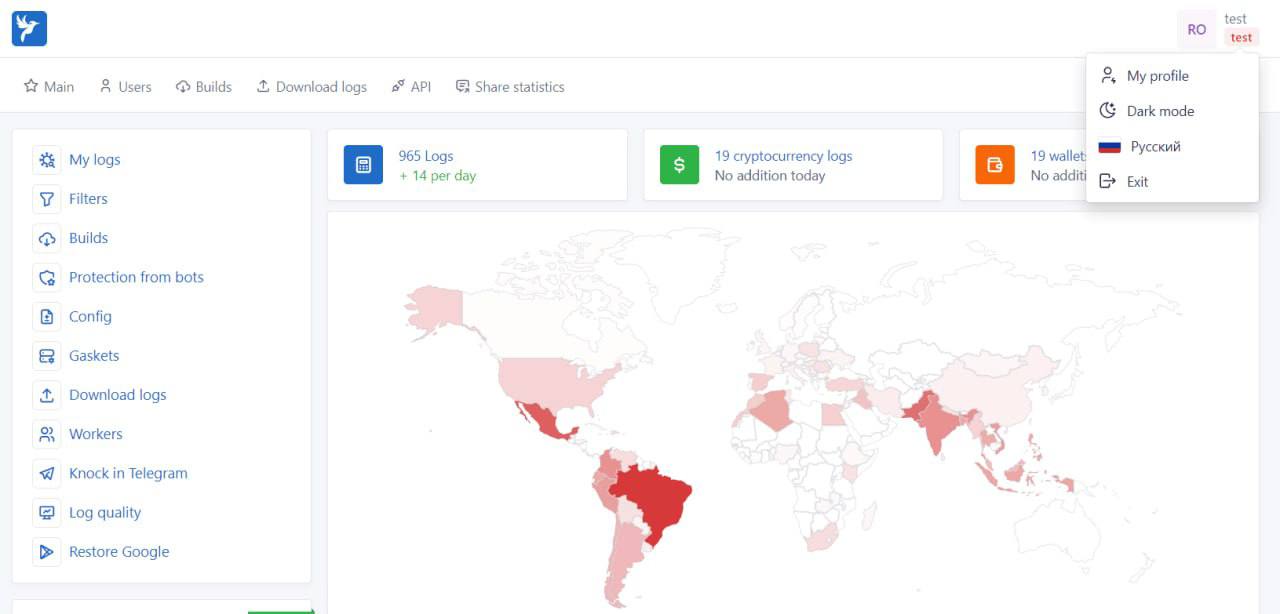
The panel itself uses the word. Screenshots from the same thread show what the customer saw. In the English interface (the user menu switches it to Russian) the left-hand menu has an entry called Gaskets, between Config and Download logs. In Russian it reads Прокладки, the same word. So a gasket was not only slang in a thread. It was a menu item in the product.
Picking one happens in a drop-down with the same name. It lists shared gaskets, numbered 1 to 10, each with a domain in brackets. The domains are blurred in the image as posted, and every one of them ends in .shop. My reading: shared means shared between customers, so a burned shared domain burns every customer on it. That is the problem a $50 gasket was sold to avoid.
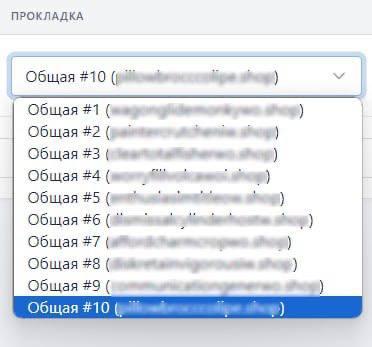
Why it matters: the panel is the front door, and a stealer business lives or dies by the reputation of the domains in front of it. $50 is cheap insurance, and it shows the seller treated domain reputation as a product. Dynamic DNS is what makes a gasket movable: the name stays and what it points to changes. It is the same instinct as the Steam fallback in section 1, put something stable between the customer and the part that gets burned.
4. The .fun registrations, August 2023
My evidence again. Domains on .fun were very popular with this crowd through 2023, and the registrations from August 2023 show the pattern most clearly:
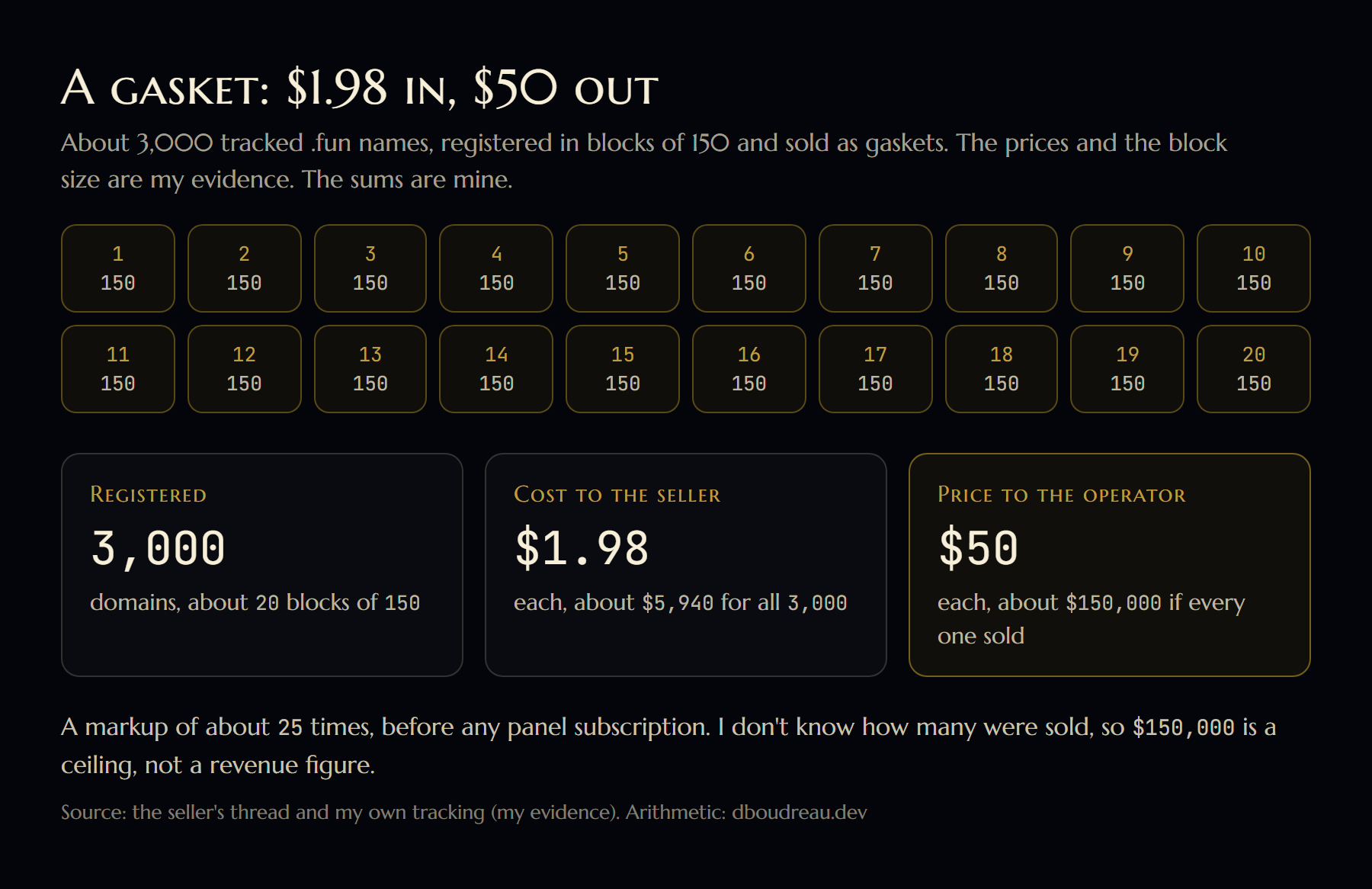
- Blocks of 150. All of the Lumma .fun domains I tracked were registered in chunks of 150 at a time, grouped in tight time blocks.
- Registrars. NiceNIC and Njalla. Njalla is a privacy service that holds the registration in its own name, so you see the service and not the person.
- Misspelled common words. Typos of ordinary words, for example outsude[.]fun for “outside”. That one is an illustration of the pattern, not a claim about any one domain.
The totals I tracked were around 3,000 names, registered for about $1.98 each and sold on as gaskets at $50 each. That is a markup of about 25 times. If every one sold it is $150,000 against about $5,940 spent, but I do not know how many sold, so that is a ceiling and not a revenue figure. The numbers are mine, and the arithmetic is below.
5. The panel behind the gaskets
Context
These screenshots come from the same selling thread. I show them as posted, with whatever blurring the poster applied, and I have changed nothing. Several are visibly test accounts (the user is named test, TEST or TESTDRIVe), so I read the counts in those as demo data. The text on screen is Russian, so the captions give my own translation of the parts that matter.
Everything is counted in one place. The main page totals logs, cryptocurrency logs and wallets, then breaks the logs down by tag. This account sees 478,690 logs, 6,645 of them new in a day, spread over ten tags, the biggest holding 179,440. A tag is set on a build and every log carries the tag of the build that made it (the API below shows both), so this is a count per build, which in practice means per campaign. My reading: a service that counts by build tag can count by customer just as easily, and so can whoever holds its database.
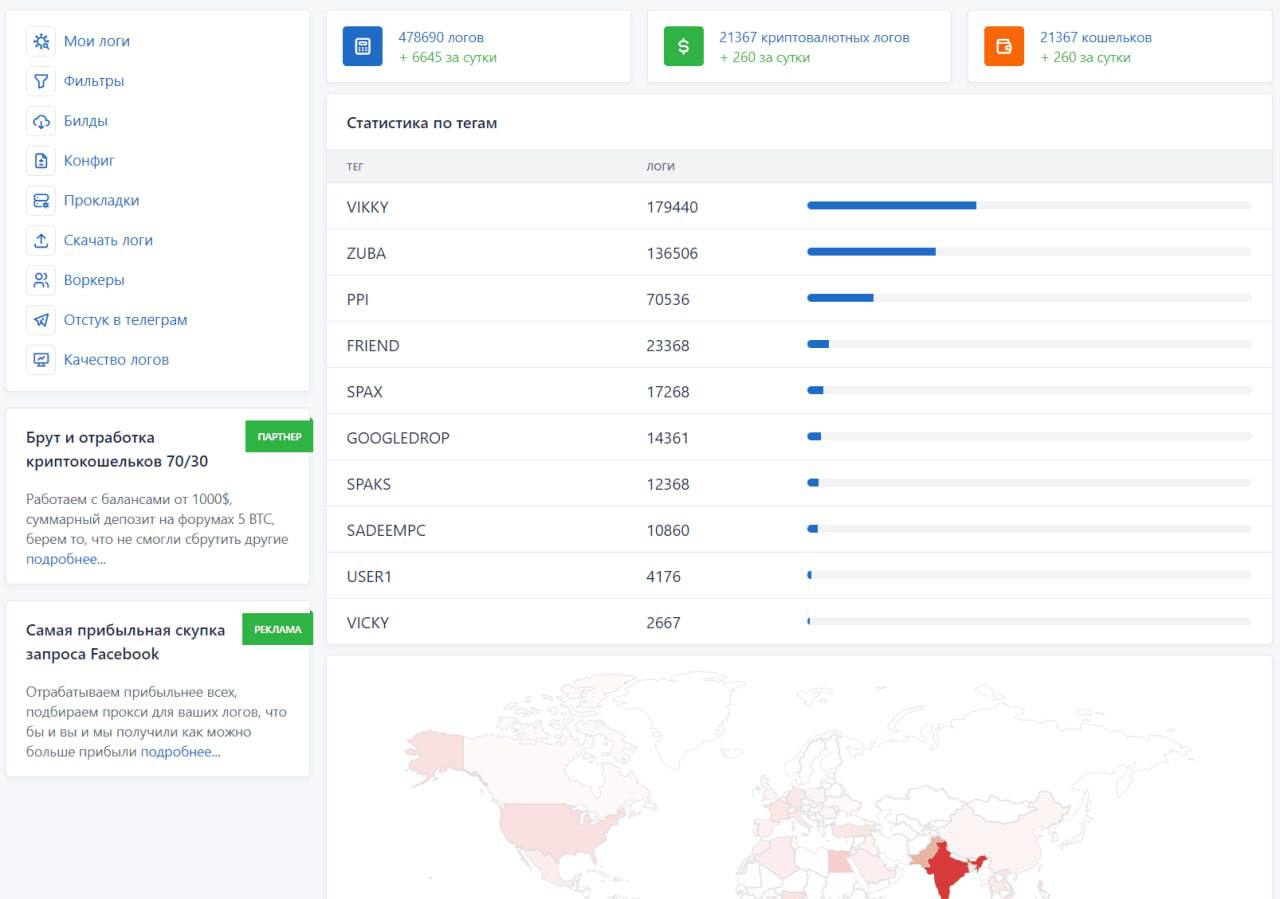
Those cards are on most of these screens. They offer a crypto drainer, removal of 2FA on crypto exchanges, brute-forcing and cash-out of wallets at a 70/30 split, and a Facebook buy-up. So the panel was also a billboard for the services that turn logs into money.
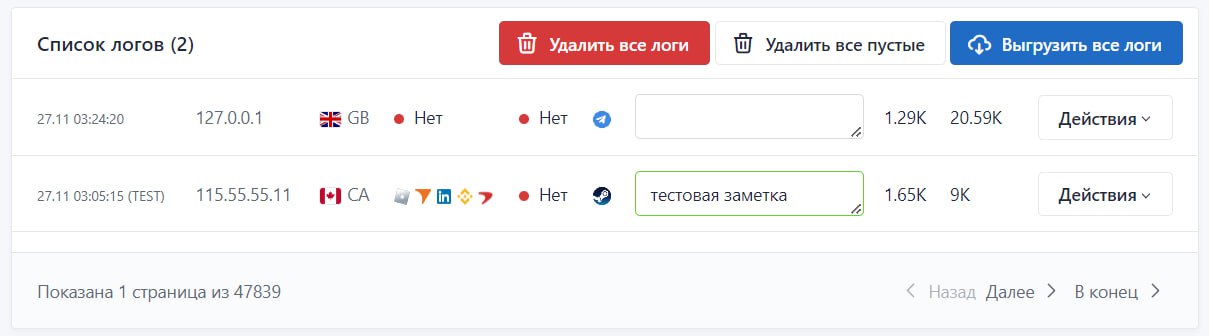
The log list is plain. Each row has a date, the IP, a country flag, two status dots, icons for the apps found in the log, a note field, two size figures and an Actions menu. Above it are three bulk buttons: delete all logs, delete all empty ones and export all. A bulk delete implies the logs stay in the panel until someone presses it (my reading). The two rows here are test entries, one from the loopback address.
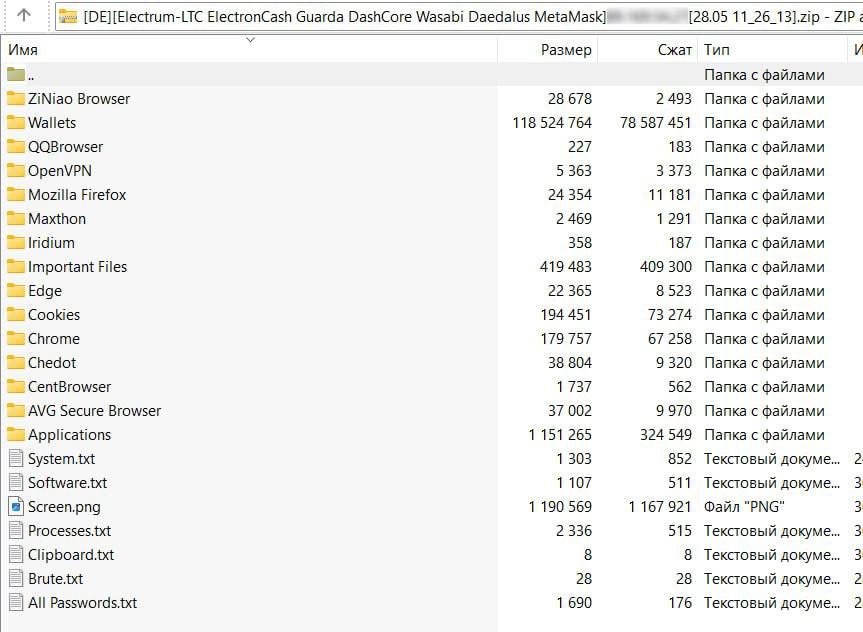
A log is a zip. The name carries the country code, the wallets found, the victim’s IP (blurred in the image) and the capture time. Inside are a folder per browser, several of them rarely seen, a Wallets folder (about 118 MB here), Cookies, a folder called Important Files, text files for the system, software, processes, clipboard and passwords, a small file called Brute.txt, and a screenshot of the victim’s desktop. Putting country and wallets in the name lets an operator sort thousands of logs by eye (my reading), and the same fields come back from the API.
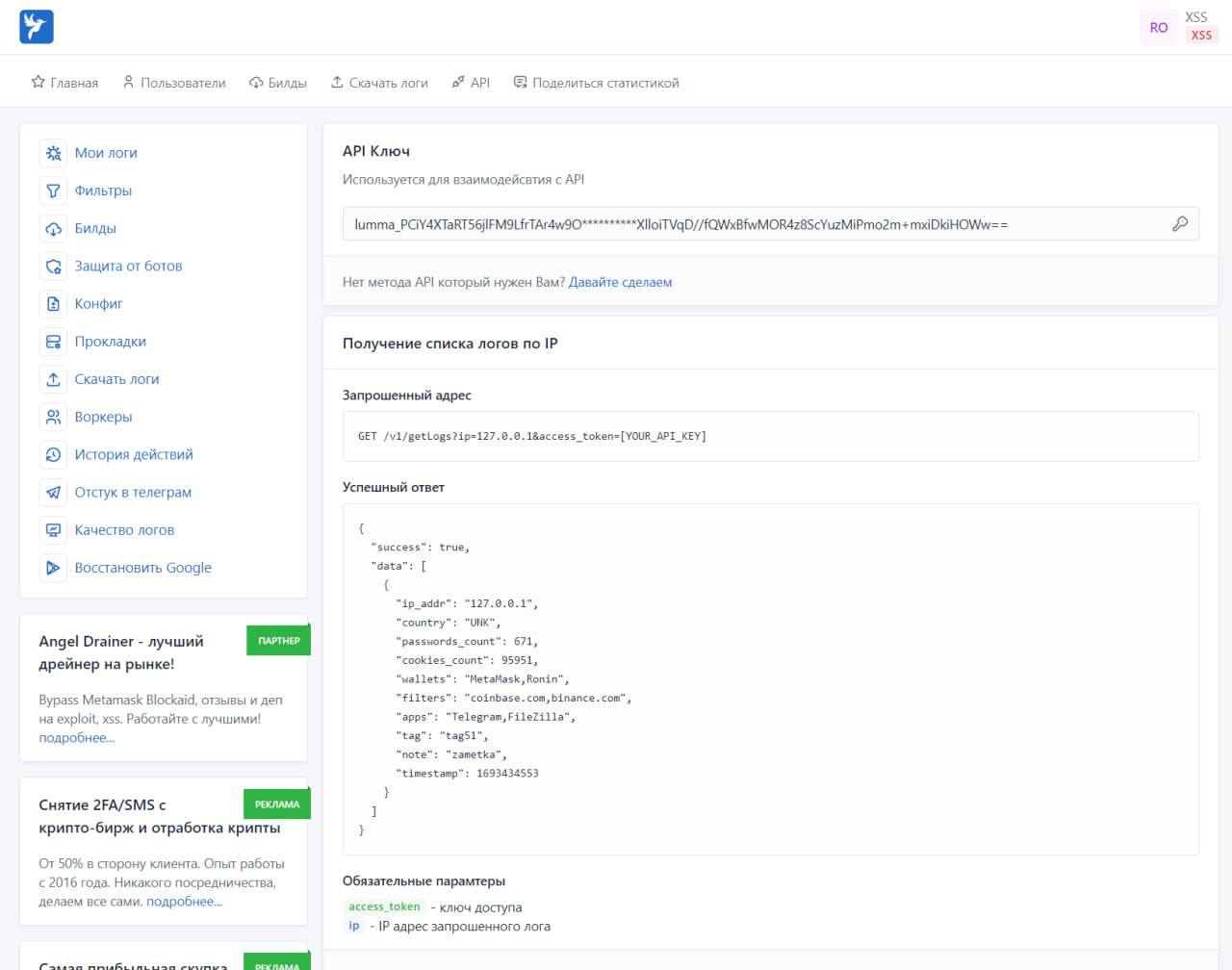
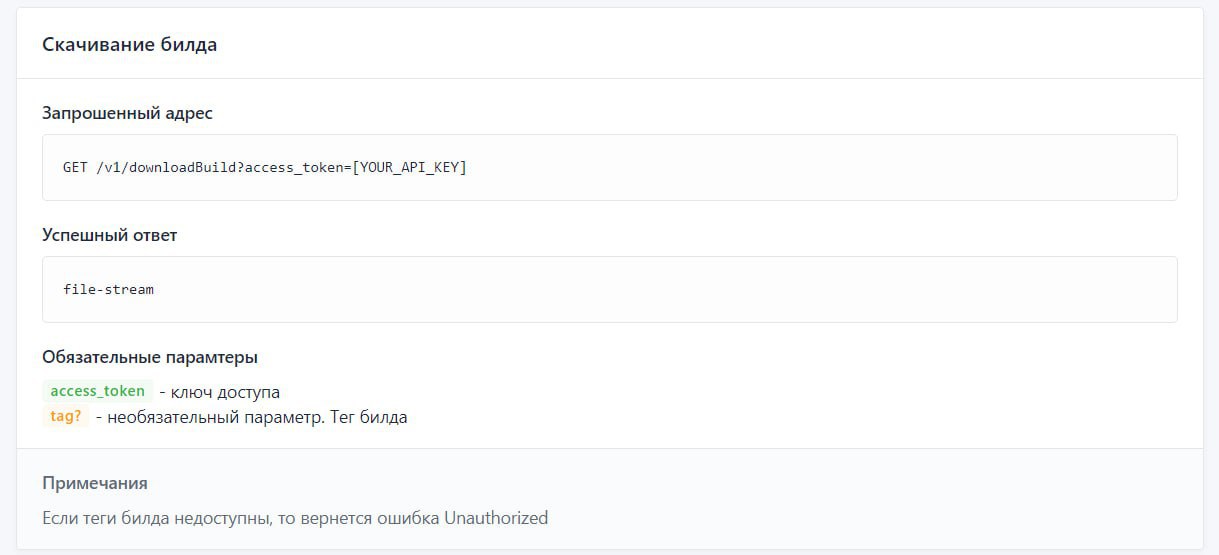
There is an API. The documentation page shows two calls. One looks logs up by the victim’s IP and returns, for each log, the IP and country, how many passwords and cookies it holds, which wallets and apps were found, which filter domains matched, the build tag, the operator’s note and a time stamp. The other downloads a build by tag. Both put the key in the query string of a GET request, so the key lands in the panel’s own access log and in any proxy that ends TLS in front of it (my reading, and a common mistake). The sample response carries the time stamp 1693434553, which is 30 August 2023, so the page was probably written that month (my reading).
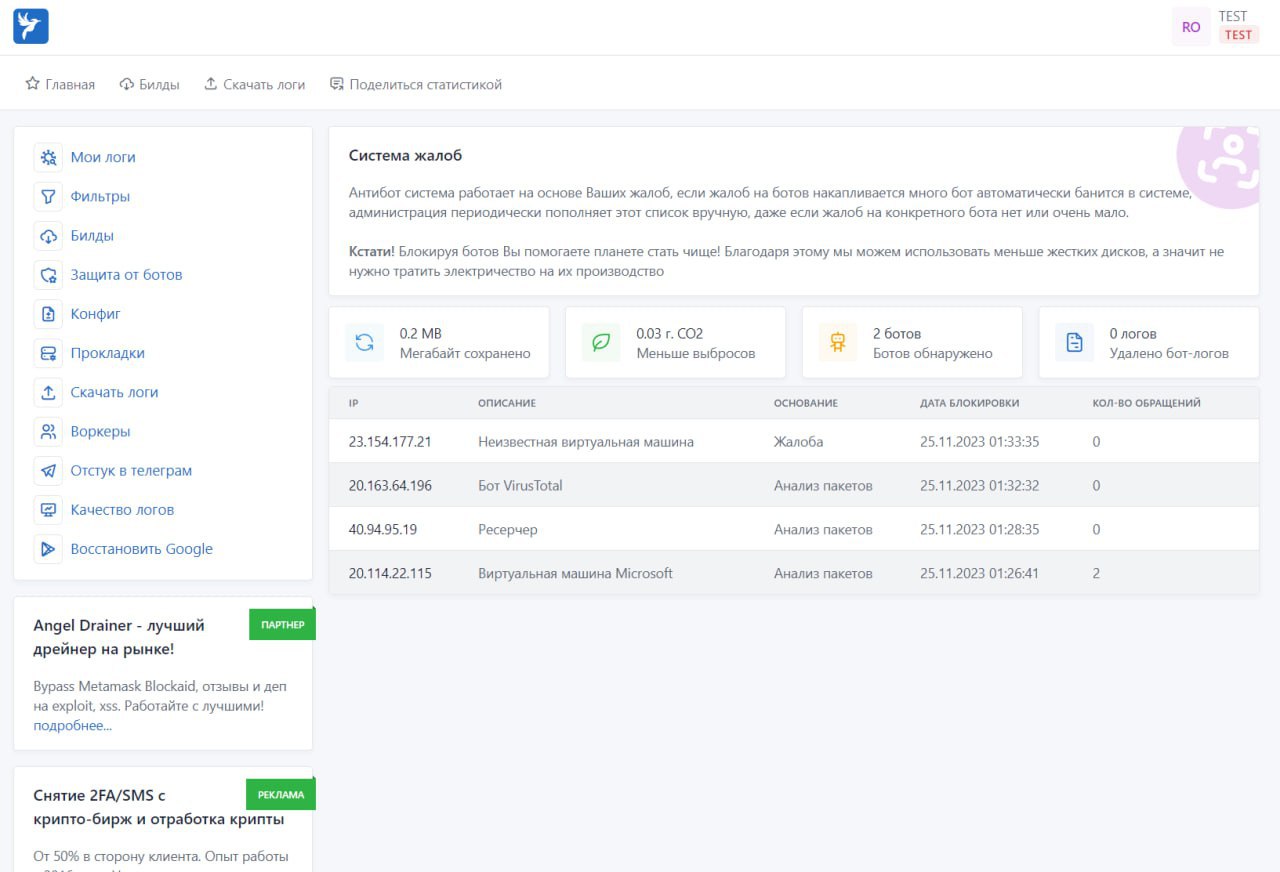
The panel also keeps a list of who is looking. The page is called the complaint system. It says the anti-bot list is built from customers’ complaints, that a bot is banned across the system once enough pile up, and that the administration adds entries by hand, even with few or no complaints. The four entries in the screenshot are described as a VirusTotal bot, a researcher, a Microsoft virtual machine and an unknown virtual machine. One is down to a complaint, the other three to packet analysis, and all four were blocked within seven minutes on 25 November 2023. The menu on that screen already has Gaskets, so the feature existed by that date, which is the firmest date these screenshots give. The page also jokes that blocking bots lets the service use fewer hard drives, which puts the customers’ logs on the seller’s own disks (my reading).
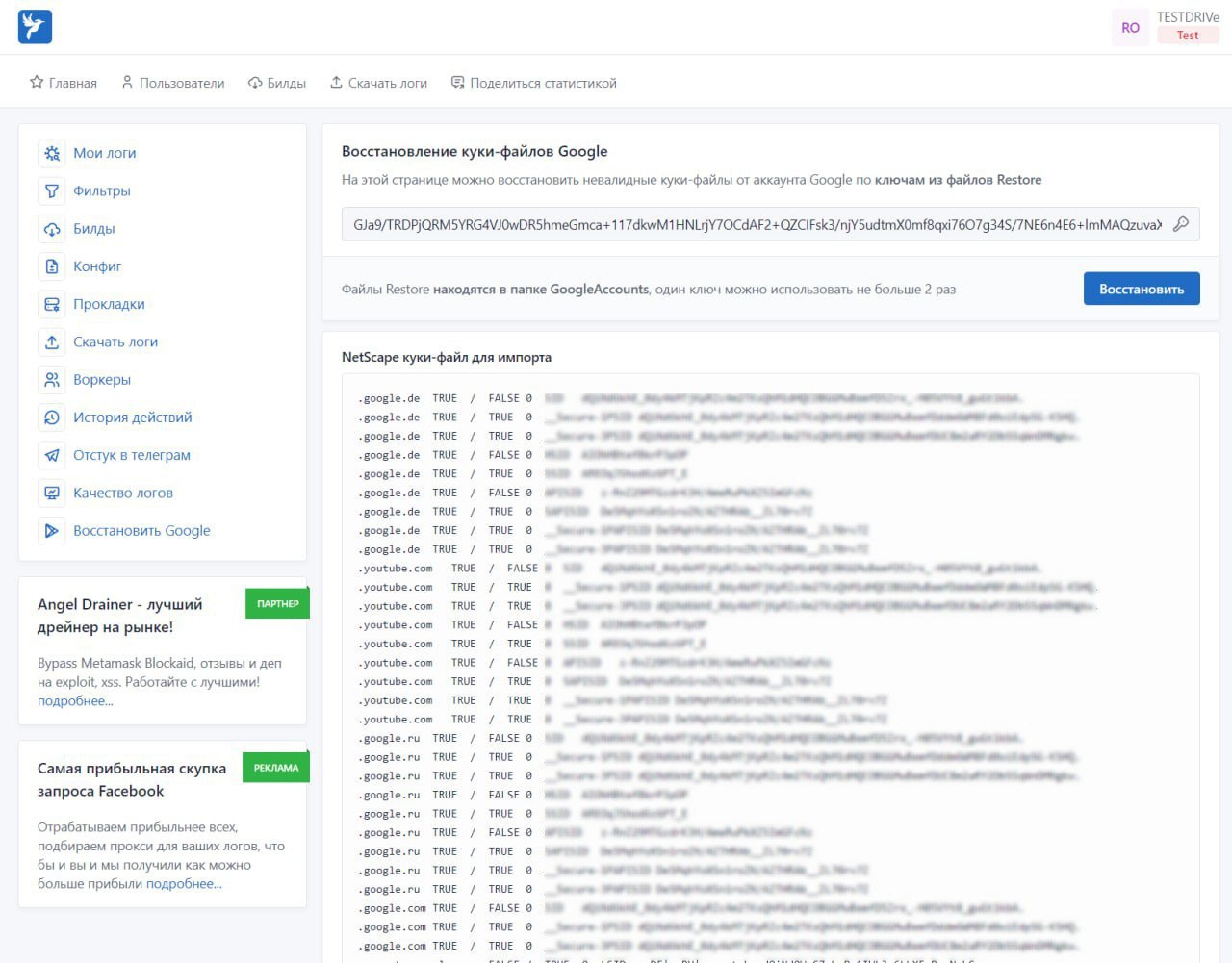
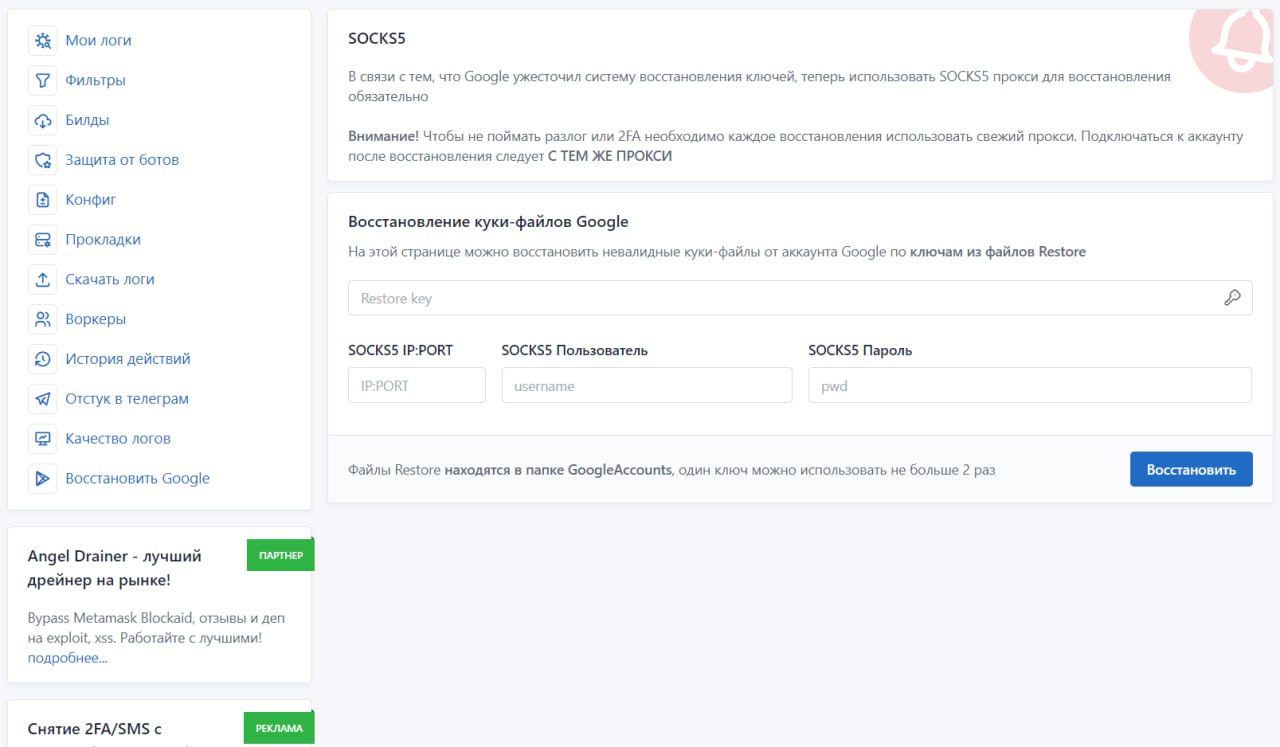
The product kept adding things. Restore Google takes a restore key from the Restore files kept in a GoogleAccounts folder and returns a cookie file in the Netscape format, ready to import, for a Google account whose cookies have gone invalid. A key can be used twice at most. In the newer version of the page (its menu has a Protection from bots entry the first one lacks) a notice says Google tightened its key recovery, so a SOCKS5 proxy is now mandatory, a fresh one for every restore, and the account must be used from the same proxy afterwards to avoid being logged out or hitting 2FA. My reading: when Google changed something, the answer shipped in the panel and reached every customer at once.
My reading of what these screens have in common: one panel, run for every customer at once. It counts, blocks and stores for everyone, and the gaskets sit in front of all of it. The next section is what that cost.
6. Why it was built to leak
A stealer sold to hundreds of customers has to solve a problem a single crew does not: every build must reach its C2 from a machine nobody controls, and the service must keep working when a domain dies. My reading is that each fix handed defenders something.
| Design choice | What defenders got |
|---|---|
| Domain list inside every sample | A map from any one sample. Changing the cipher only delayed the reading |
| Fallbacks on Steam and Telegram | A second map in public places, plus a named profile or channel to report |
| Customer and campaign IDs on every request | Clusters by customer without knowing a name |
| Shared tier-1 domains, paid personal ones | Overlap where shared, one customer’s whole footprint where personal |
| Gaskets (dynamic DNS) in front of the panel | A swappable layer for the operator, and a naming pattern for the defender (my evidence) |
| Shared gaskets, and one anti-bot list for every customer | One sighting covers many customers: a shared gasket is the same domain for everyone on it (my evidence) |
| Cheap TLDs, a privacy registrar, batch registration | Groupable at registration, before a sample exists (my evidence) |
| One reverse proxy in front of everything | One partner with a view across the whole service. Cloudflare is a named partner, and what it did is not published |
| A panel customers must log in to | Five domains that had to be told to everyone |
7. May 2025: what the map was worth
Microsoft’s Digital Crimes Unit filed suit on 13 May 2025 in the Northern District of Georgia. It says the order let it seize, take down, suspend or block about 2,300 domains. More than 1,300 were seized by or moved to Microsoft and are redirected to sinkholes, including about 300 actioned by law enforcement with Europol’s support. Microsoft counted more than 394,000 infected Windows computers worldwide between 16 March and 16 May 2025.
The Justice Department’s part was separate: two warrants covering five “user panel” domains, the login pages customers and administrators used to deploy the malware. Two were seized on 19 May. On 20 May the operators told their users about three replacement panel domains, and the government seized those on 21 May. The FBI says it identified at least 1.7 million instances of Lumma stealing credentials. Partners named across the reports: ESET, Bitsight, Lumen’s Black Lotus Labs, Cloudflare, CleanDNS, GMO Registry and Europol, with Japan’s cybercrime centre handling locally hosted infrastructure.
| Figure | Who | What it counts |
|---|---|---|
| 3,353 | ESET | Unique C&C domains in samples, 17 June 2024 to 1 May 2025, about 74 new a week |
| about 2,300 | Microsoft, Justice Department | Domains covered by the civil action |
| 1,300+ | Microsoft | Domains seized or moved to Microsoft for sinkholing |
| over 1,000 | Bitsight | Domains seized, plus 90+ Telegram channels and Steam profiles |
| 5 | Justice Department | User-panel domains seized under warrant |
These are different scopes, not a contradiction. ESET counts what appeared in samples over a long window, Microsoft counts what the order covered, the Justice Department counts the panels.
How it was mapped: ESET describes automated processing of tens of thousands of samples to pull out C&C servers and customer identifiers. Nobody had to scan the internet for them. Bitsight reports finding over 1,000 tier-1 domains, 63 primary domains, 93 Telegram channels and 17 fallback domains across 4 Steam profiles. Microsoft does not explain how its team verified the 2,300, and I am not guessing.
The panel announcement on 20 May is the clearest case of the design leaking: a service that has to tell hundreds of customers where its front door moved cannot tell only the customers (my reading).
Redacted
Information from the seized panel: [Redacted]. The investigation is ongoing and I am unable to share it at this time.
8. After the takedown
Trend Micro reported infrastructure ramping up again within weeks, with operators moving to other hosting providers and away from public forums (as summarised by SC Media). From late August to early October 2025 a site called “Lumma Rats” published personal and financial details it said belonged to five people involved with Lumma. Trend Micro says it has not verified any of it, does not know who ran the campaign, and suggests rivals. It also notes the official Telegram accounts were reportedly compromised on 17 September 2025. Trend’s telemetry showed detections and C&C activity falling from early September, with customers moving mainly to Vidar and StealC. That is a correlation with the exposure campaign, not a proven cause.
Context
I am not confirming, repeating or linking any of the doxxed details. The investigation is still ongoing, and a leaked list of names is not evidence on its own.
The takedown did not end Lumma. Its customers’ loss of trust, and a rival campaign, may have done more damage over the following months than the seizure did, which says something about where the weak point of this business is. lol.
9. What defenders can do with it
- Treat a stealer sample as an indicator source. The config you pull out is the intel.
- Cluster on customer and campaign IDs, not domains. The domains rotate and the IDs do not.
- Alert on newly registered domains one edit away from a common word, especially on cheap gTLDs, and group by registrar and registration block. The August 2023 .fun batches are the example.
- Track dynamic DNS names that point at the same panel infrastructure over time. A gasket that moves is still a gasket.
- Watch the fallbacks. A Steam profile or Telegram channel whose name turns into a domain-shaped string is a signal, and a report is cheap.
- Remember that seizure does not clean the victim. A sinkholed domain tells you who was infected, and removes nothing. Microsoft’s own guidance covers delivery (phishing, malvertising, cracked software, ClickFix pages) and the usual controls: tamper protection, network protection, EDR in block mode and phishing-resistant MFA.
References
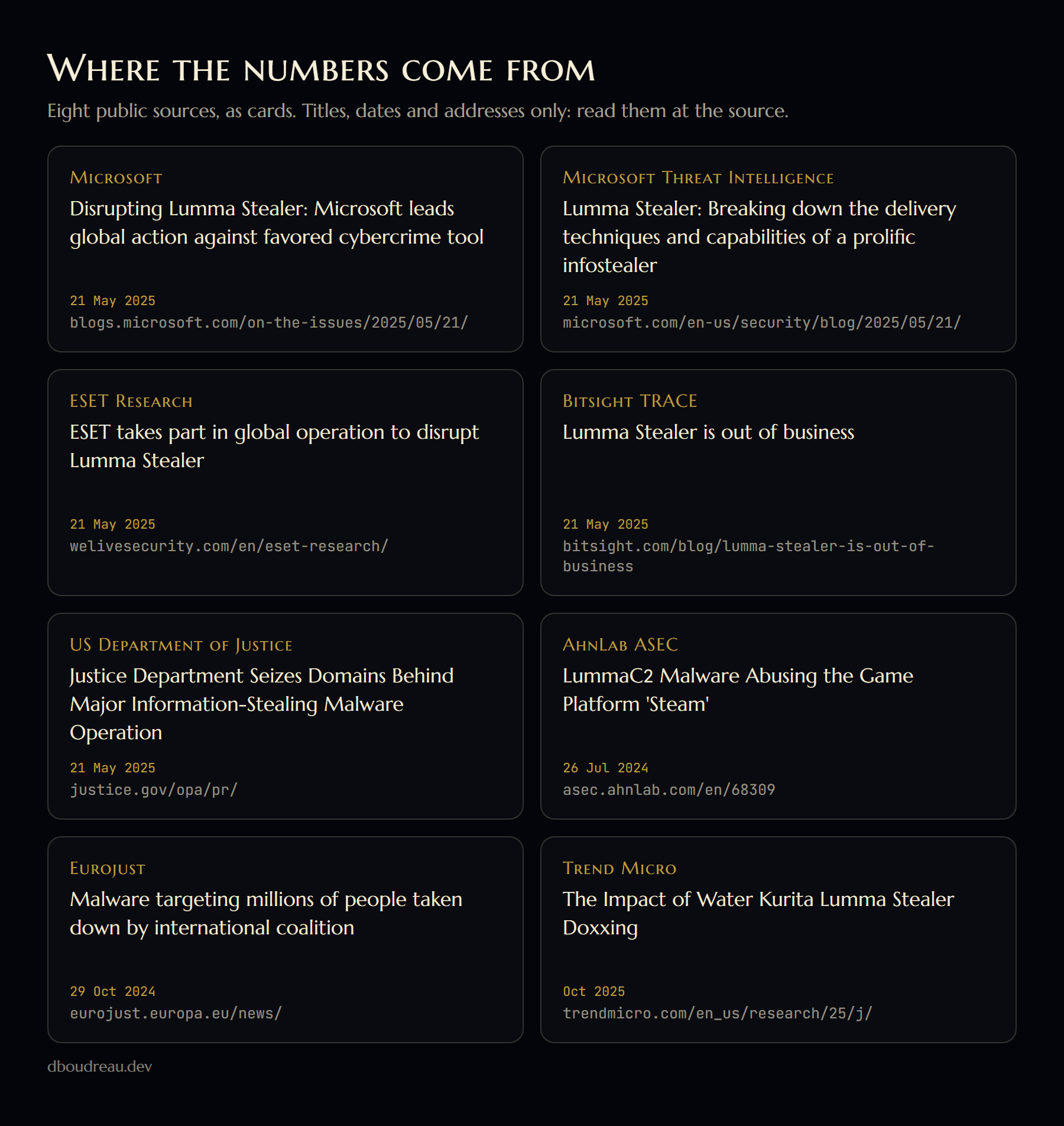
- Microsoft On the Issues, “Disrupting Lumma Stealer: Microsoft leads global action against favored cybercrime tool” (21 May 2025): blogs.microsoft.com.
- Microsoft Threat Intelligence, “Lumma Stealer: Breaking down the delivery techniques and capabilities of a prolific infostealer” (21 May 2025): microsoft.com.
- ESET Research, “ESET takes part in global operation to disrupt Lumma Stealer” (21 May 2025): welivesecurity.com.
- Bitsight TRACE, “Lumma Stealer is out of business” (21 May 2025): bitsight.com.
- Justice Department, “Justice Department Seizes Domains Behind Major Information-Stealing Malware Operation” (21 May 2025): justice.gov.
- AhnLab ASEC, “LummaC2 Malware Abusing the Game Platform ‘Steam'” (26 July 2024): asec.ahnlab.com.
- Red Canary, LummaC2 (Threat Detection Report entry): redcanary.com.
- Trend Micro, “The Impact of Water Kurita Lumma Stealer Doxxing” (October 2025): trendmicro.com.
- SC Media, “Lumma infostealer recovers from global clampdown”: scworld.com.
- g0njxa, “Approaching stealers devs: a brief interview with LummaC2” (November 2023, as linked by Microsoft; Medium blocks automated readers, so I have not read it myself): g0njxa.medium.com.
- Eurojust, “Malware targeting millions of people taken down by international coalition” (29 October 2024): eurojust.europa.eu.
- Justice Department (Western District of Texas), “U.S. joins international action against RedLine and META infostealers” (Operation Magnus, October 2024): justice.gov.
- dboudreau.dev, LummaC2: Unpack & YARA (14 May 2023).
- My evidence: Lumma’s main selling thread, the seller’s Telegram channel and my own tracking (SHA-256 of originals kept offline).